Hi all, due to me putting more focus on my interest in the Edwardian era recently, i've set up a new blog for all things Edwardian, covering 1901-1919. I'll certainly be updating this blog more often, especially as I have a lot more material to draw from, however i'll try and update this one when I find something interesting to put up, or even just the occasional picture.
Please have a look at my new blog and follow it, and I hope it will be of interest.
http://electric-edwardians.blogspot.com
Thursday, 30 June 2011

Saturday, 22 January 2011
REO Speed Wagon
Firstly, my apologies for the long delay in posting - work, moving etc have got in the way so haven't found the time to do so.
Despite the title, this post isn't about an American Rock Band - it's about a bus. REO was an American motor car manufacturer, who later made a type of truck known as the REO Speed Wagon, a name used for over twenty years for various light-trucks and fire engines, busses etc built on the same chassis. This 1925 REO Speed Wagon was given a bus body, and is now owned by the Black Country Living Museum (http://www.bclm.co.uk), where it is seen in these photographs taken on a rainy day in 2008.

This very REO Speed Wagon was used in an episode of 'Jeeves & Wooster', Series 2 Episode 5, 'The Mysterious Stranger', painted blue, seen here;
http://imcdb.org/vehicle_69181-REO-Speed-Wagon-1925.html

Despite the title, this post isn't about an American Rock Band - it's about a bus. REO was an American motor car manufacturer, who later made a type of truck known as the REO Speed Wagon, a name used for over twenty years for various light-trucks and fire engines, busses etc built on the same chassis. This 1925 REO Speed Wagon was given a bus body, and is now owned by the Black Country Living Museum (http://www.bclm.co.uk), where it is seen in these photographs taken on a rainy day in 2008.

This very REO Speed Wagon was used in an episode of 'Jeeves & Wooster', Series 2 Episode 5, 'The Mysterious Stranger', painted blue, seen here;
http://imcdb.org/vehicle_69181-REO-Speed-Wagon-1925.html

Monday, 5 July 2010
Alvis to continue production of 1936 car!

Amazing news from Alvis that they are to reproduce the 1936 Alvis 4.1 Litre sports car. Time to save up the pennies!
Alvis, arguably one of the most innovative car manufacturers in the 1930s, is set to return to business in the 21st century with ownership of the brand name having been formally transferred to Red Triangle, which for the last 40 years has been providing parts and restoration services to Alvis owners and has also been the safe custodian of all the original designs, plans and complete historic record of the cars produced.
With the legal transfer of the Alvis car trademarks, Red Triangle has formed a new company called The Alvis Car Company Limited. There is evidence from the original Alvis company board minutes that seventy-seven of the chassis that were officially sanctioned for production were never fulfilled because car production had to be suspended in 1940.
The newly formed Alvis Car Company will announce details of a continuation series of these cars at Goodwood and will be displaying on their stand a brand new 4.3 Litre chassis and engine. These are the first steps towards the reintroduction of the famous Alvis 4.3 Litre model, 71 years after the last 4.3 Litre Alvis was produced.
The 4.3 Litre Alvis was the fastest non-supercharged production car of its day, and the continuation series will live up to that heritage. Manufactured from the original drawings, the 4.3 Litre Alvis in-line six cylinder engine will be faithful to the 1936 design, in maintaining all its period character and quality, yet by utilising modern technology it will be emission compliant. Moreover, by using modern materials, fuel injection and engine management, this powerplant will deliver even more horsepower.
Image and quote from http://www.alviscars.co.uk/alviscars.php
Saturday, 3 July 2010
Railway Air Services Winter Timetable, 1938
Fantastic cover from Railway Air Services winter timetable, published September 12 1938, showing a de Havilland DH.86 Express

From the collection of Björn Larsson at Airline Timetable Images http://www.timetableimages.com/ttimages/ras.htm

From the collection of Björn Larsson at Airline Timetable Images http://www.timetableimages.com/ttimages/ras.htm
Thursday, 24 June 2010

Morall's Gentlemans' Outfitters

A recreated building at the Black Country Living Museum depicting a menswear shop typical of the 1930s

To see the building, and others, visit the Black Country Living Museum website http://www.bclm.co.uk
Tuesday, 22 June 2010
Great Western Railway Air Services Part Two

The GWR Air Services were very succesful, and was one of the forerunners of the UK Domestic Airlines that operate today such as easyJet and Flybe. However, they only operated for a single season - in 1934, the airline Railway Air Services was formed, a collaboration of all four main railway companies - the Great Western Railway, the Southern Railway, the London Midland and Scotland Railway and the London North Eastern Railway
Thursday, 17 June 2010
Broome's Garage 1936

Another building at the Black Country Living Museum, this time a replica of the Conway Garage at Sedgley Road, Dudley, run by mechanic Alex Broome. Alex Broome was a racing mechanic for Sunbeam, including being involved with the 1927 1000hp land speed record car nicknamed 'The Slug', but started his own garage in 1936 which ran for many years.

For more information on the garage and Alex Broome, you can view this .pdf file http://www.bclm.co.uk/downloads/a4_broomes_garage.pdf

You can see the replica garage, as well as a larger sales garage used as a car museum, at the Black Country Living Museum http://www.bclm.co.uk

Wednesday, 16 June 2010
Petrol Pumps
Selection of 1930's petrol pumps at the Black Country Living Museum garage

National Benzole

Shell

BP (British Petroleum)

National Benzole

Shell

BP (British Petroleum)
Monday, 14 June 2010
Streamlined Royal Mail Car
British Pathe clip showing a GPO streamlined car, used for publicity purposes on the Royal Air Mail Service runs to Croydon Airport, and loading an Imperial Airways Handley Page HP42 Airliner
G.P.O STREAMLINED
Monday, 7 June 2010

Great Western Railway Air Services
The Great Western Railway, also known as the GWR, and then also known as 'God's Wonderful Railway', the 'Great Way Round' or 'Goes When Ready' was one of the 'Big Four' railway companies in the UK between 1923 and 1948, when they were nationalised to form British Railways. The GWR never missed a trick, and had superb publicity to take advantage of the achievements and new developments the railway was doing. One area where the GWR lead the way was in developing its own Airline.

The Great Western Railway Air Services commenced operations in April 1933, operating between Birmingham and Plymouth, with Cardiff, Teignmouth and Torquay en-route. The service consisted of one aircraft, a three-engined Westland Wessex, owned by Imperial Airways, and painted in brown and cream, the traditional colour for GWR passenger carrying vehicles, such as the railway carriages, streamlined diesel railcars, and motor busses.

Timetable dated May 22 1933, from the collections of Björn Larsson http://www.timetableimages.com/ttimages/gwr.htm

The Great Western Railway Air Services commenced operations in April 1933, operating between Birmingham and Plymouth, with Cardiff, Teignmouth and Torquay en-route. The service consisted of one aircraft, a three-engined Westland Wessex, owned by Imperial Airways, and painted in brown and cream, the traditional colour for GWR passenger carrying vehicles, such as the railway carriages, streamlined diesel railcars, and motor busses.

Timetable dated May 22 1933, from the collections of Björn Larsson http://www.timetableimages.com/ttimages/gwr.htm
Hobbs and Sons Fish & Chip Shop
The Black Country Living Museum, located in Dudley in the West Midlands (near Birmingham) has many relocated buildings from British history, especially from the Victorian-1930s era. The 1930s street is the newest development, and one of the first buildings to be opened was the Fish & Chip Shop, no doubt to relieve the strain on the much smaller 1920s Fish & Chip Shop which is always overwhelmed by demand!

The Fish & Chips are cooked in beef dripping and taste superb, and you can get scraps as well - for more information visit http://www.bclm.co.uk

The Fish & Chips are cooked in beef dripping and taste superb, and you can get scraps as well - for more information visit http://www.bclm.co.uk
Friday, 16 April 2010
Austin 10
Austin 10 fitted with a blackout mask to the headlamp, as fitted in the Second World War to reduce the glare from the headlamp to avoid being seen from the air (which also made driving at night a lot more dangerous)

Seen at the Chiltern Open Air Museum WW2 Weekend, March 28 2010

Seen at the Chiltern Open Air Museum WW2 Weekend, March 28 2010

Thursday, 11 March 2010

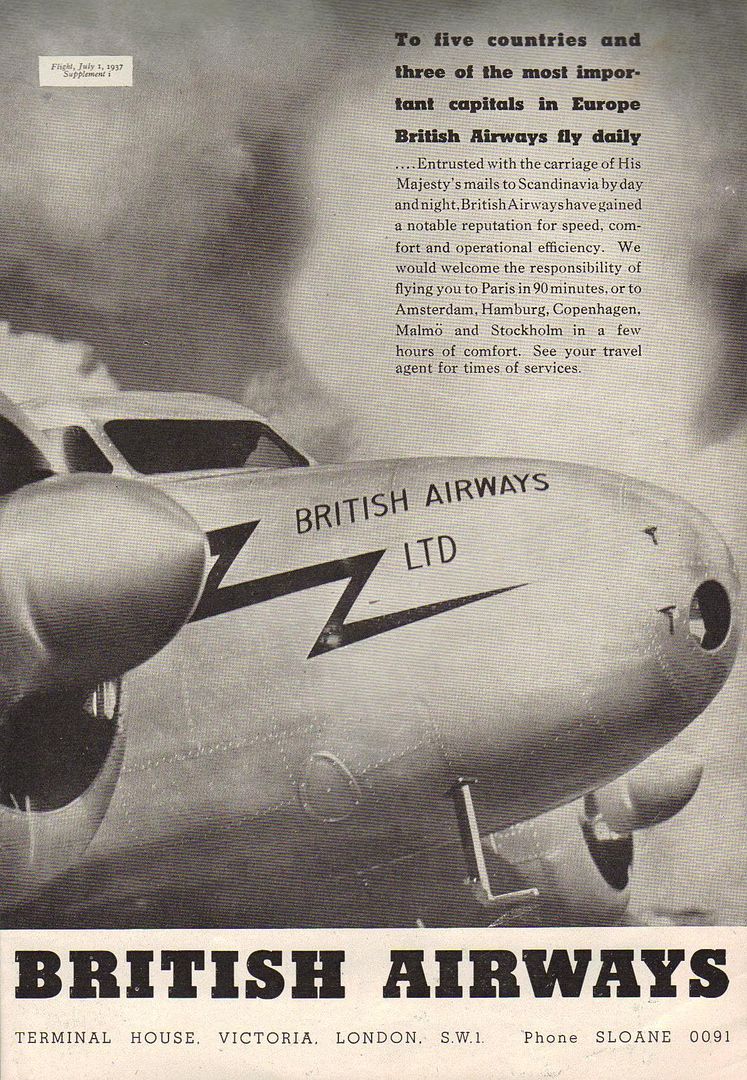
British Airways advert, 1937

From a 1937 issue of Flight magazine
Featuring a Lockheed 10a Electra
Full size - http://i282.photobucket.com/albums/kk256/RobLangham/baad.jpg
Sunday, 7 March 2010
Thompson Aircraft Refueller Part Two

I've already mentioned the Thompson aircraft refueller, a common sight at airfields and airports in the 1930's, here http://art-deco-uk.blogspot.com/2009/08/thompson-aircraft-refueller.html , and came across this great advert marketing them in the July 1 1937 issue of Flight magazine, still going today and with an online archive of past issues, accessible here http://www.flightglobal.com/
Now the weather is finally improving i'm hoping to make it down to Brooklands before too long, would be nice to get a better photograph of the Thompson refueller, and hopefully the paintwork will be in better condition too

Friday, 2 October 2009
1936 Riley TT Sprite Le Mans

Seen at the Vintage Sports Car Club's Mallory Park race meeting on 23rd August was this superb 1936 Riley TT Sprite. The bodywork is unlike that of most other Riley TT Sprite's because, in 1937, a French team was formed to enter race meetings equipped with three Riley TT Sprite's fitted with this bodywork for streamlining, built by Maurice Pourtout a Paris coachbuilder. As well as entering various high profile races, such as at the Autodrom at Montlhery, they were most well known for entering the 1937 Le Mans.


Unfortunately the original bodywork of these three cars hasn't survived, so this is a replica built using photographs of the team's cars - the attention to detail is superb, including a sign on the dashboard for 'M PourTout'

Mignet Pou-du-Ciel
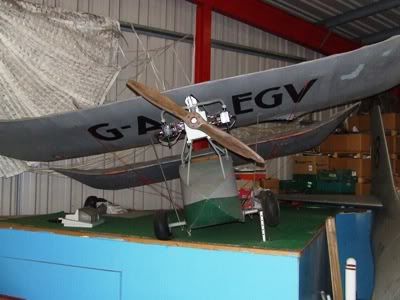
The Mignet Pou-du-Ciel, known as the 'Flying Flea' in the United Kingdom although the name translates into 'Louse of the Sky', was a home built aircraft, first flying in 1933 with the book containing plans and instructions becoming available in 1934. Powered by a motorcycle engine and needing very little storage space due to their small size, they were at first very popular with budding aeronauts in many country.
However, a series of fatal accidents led to groundings or bans in most countries in which they were flown in, and, although a solution to the problem was solved (they had a tendency to be unable to pull out of shallow dives), the dangerous reputation they had by then received many remained firmly on the ground. This surviving example is on display at the Midland Air Museum, Coventry
However, a series of fatal accidents led to groundings or bans in most countries in which they were flown in, and, although a solution to the problem was solved (they had a tendency to be unable to pull out of shallow dives), the dangerous reputation they had by then received many remained firmly on the ground. This surviving example is on display at the Midland Air Museum, Coventry
Subscribe to:
Posts (Atom)